


_1750233969309.png)
Customizing Machine Stretch Film Roll solutions through OEM/ODM partnerships transforms standard packaging operations into precision-engineered systems. Professional manufacturers collaborate with enterprises to develop specialized stretch films that meet specific operational requirements, material specifications, and performance standards. These partnerships enable businesses to achieve optimal load securing while maintaining cost efficiency and supply chain reliability. Through comprehensive customization programs, companies access tailored packaging film solutions that enhance product protection, streamline operations, and deliver measurable performance improvements across diverse industrial applications.
Understanding OEM vs ODM Manufacturing Models
Businesses are able to take use of pre-existing stretch wrap formulas via the use of Original Equipment Manufacturing (OEM), which also allows for the application of customized branding and requirements. Detailed specifications for their Machine Flexible Film Roll demands are provided by companies. These requirements include thickness parameters, breadth measurements, and performance qualities. The manufacturer creates these films in accordance with the requirements provided by the customer by using tried and tested manufacturing methods and quality control systems.
The term "original design manufacturing" (ODM) refers to a more all-encompassing method in which manufacturers create completely new pallet wrap technologies. This model is suitable for businesses that need novel film qualities, one-of-a-kind material compositions, or other performance characteristics that are specialized. In most cases, ODM collaborations entail collaborative development stages, during which both parties contribute their respective areas of expertise to the process of producing excellent packaging film goods.
The selection between OEM and ODM depends on specific operational requirements, budget considerations, and timeline constraints. OEM arrangements generally offer faster implementation and lower development costs, while ODM projects deliver breakthrough innovations and competitive advantages through proprietary film technologies.
Essential Customization Parameters for Machine Films
The film gauge is the primary characteristic that makes a difference in terms of both cost and efficiency. Cast stretch film normally comes in gauges ranging from 40 to 120, with each thickness having a unique set of qualities that are advantageous for certain applications. However, heavier gauges provide improved tear resistance and pressure stability. Thinner gauges offer cost savings and lower consumption of resources, while heavier gauges offer both of these benefits.
It is possible for stretch film strength to vary greatly depending on the production techniques and the compositions of the materials. Because of its high memory capabilities and cling characteristics, blown stretch film is an excellent choice for use in locations that are difficult to work in and conditions that are unpredictable. Cast films have exceptional clarity and a constant thickness, which contributes to the optimization of machine packaging efficiency and the exploitation of materials.
Specifications for width have a direct influence on the efficiency of wrapping and the prices of materials. There are a variety of standard widths for industrial film, including 12, 15, 16, 18, and 20 inches; however, unique dimensions are available to fit particular machine designs. There is a correlation between the core size selection and compatibility with stretch film projectors and automation wrapping systems that are already in use.
Material efficiency and payload containment force are both determined by the pre-stretch capabilities of a material. High-performance films are able to accomplish elongation of between 250 and 300 percent while maintaining their holding strength consistently. New formulations make it possible to secure loads more effectively while simultaneously reducing the amount of film used, which results in demonstrable cost reductions throughout high-volume operations.
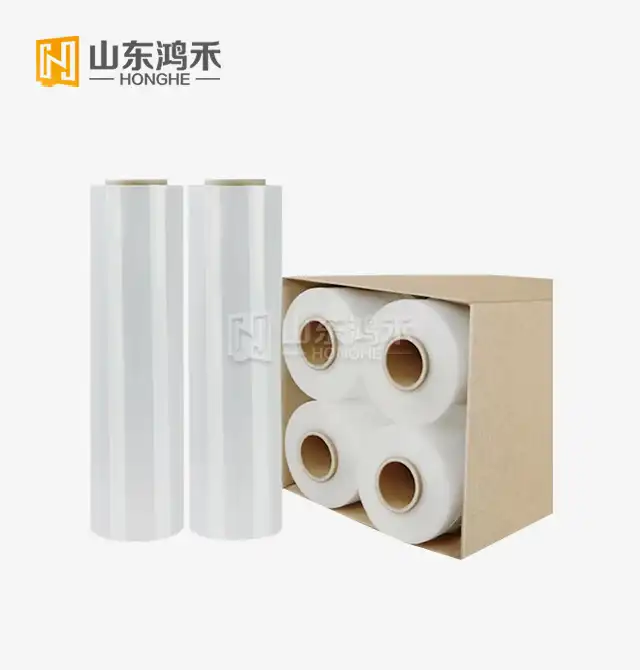
Material Specifications and Performance Requirements
Linear Low-Density Polyethylene (LLDPE) serves as the primary material for most Machine Stretch Film Roll applications. This polymer delivers excellent puncture resistance, tear strength, and elongation properties essential for reliable load containment. Advanced LLDPE formulations incorporate specialized additives that enhance specific performance characteristics.
Metallocene catalysts create superior film structures with enhanced clarity and strength properties. These advanced materials enable thinner film constructions, as seen in premium Machine Stretch Film Roll products, without compromising performance, reducing material consumption while maintaining load security. Metallocene-based protective film offers exceptional puncture resistance and elongation recovery.
Anti-static additives prevent dust accumulation and improve film handling characteristics in automated environments. These formulations particularly benefit electronics packaging and clean room applications where static control remains critical. UV stabilizers extend film performance in outdoor storage and transportation applications.
Food-grade certifications ensure compliance with regulatory requirements for direct food contact applications. These specialized formulations meet FDA, EU, and other international standards while maintaining superior mechanical properties. Medical-grade variants satisfy stringent contamination and safety requirements for pharmaceutical and healthcare applications.
Quality Control and Certification Requirements
Certification to the ISO 9001 standard constitutes the establishment of core quality management systems that guarantee constant manufacturing standards. This certification verifies the production methods, paperwork procedures, and continuous enhancement tactics that are necessary for the application of stretch film in a reliable manner across a variety of industrial settings.
A certification that bears the CE mark verifies that a product satisfies European safety and efficacy criteria for its packaging materials. This accreditation has a particularly significant influence on international markets and operations that need consistent quality assurance across multinational corporations. The clearance of the FDA permits applications that include food contact as well as pharmaceutical packaging purposes.
BSCI certification demonstrates ethical manufacturing practices and supply chain responsibility. This standard increasingly influences procurement decisions as enterprises prioritize sustainable sourcing and social responsibility. WCA certification further validates workplace safety and environmental compliance.
The statements made about the performance of films are validated by third-party testing, which involves independent laboratory examination. The dart impact resistance, bending strength measurement, flexibility testing, and rupture resistance assessment are all examples of standard tests conducted on the material. These exhaustive evaluations guarantee that the transparency film satisfies the stated performance requirements in situations that are representative of the actual world.
Customization Process and Development Timeline
Initial consultation establishes specific performance requirements, application parameters, and volume projections. Technical teams evaluate existing packaging processes, identify optimization opportunities, and recommend suitable film specifications. This assessment phase typically requires 1-2 weeks depending on application complexity.
Sample development follows consultation with prototype films, such as those for a Machine Stretch Film Roll, manufactured according to preliminary specifications. These samples undergo comprehensive testing in actual operating conditions, allowing performance validation before full-scale production. The sampling phase generally spans 2-3 weeks including production and shipping time.
Performance testing evaluates film behavior under actual operating conditions including load types, environmental factors, and equipment compatibility. This validation process identifies any necessary specification adjustments and confirms optimal performance parameters. Testing typically requires 1-2 weeks depending on application complexity.
Production setup involves equipment configuration, quality system implementation, and initial production runs. Manufacturing teams establish production parameters, calibrate quality control systems, and validate output consistency. This phase typically requires 2-4 weeks depending on specification complexity and order volume.
Cost Optimization and Volume Considerations
Volume commitments significantly impact pricing structures and minimum order requirements. Annual volume agreements enable more competitive pricing through production efficiency improvements and raw material procurement advantages. These arrangements particularly benefit enterprises with predictable consumption patterns and stable demand.
Material optimization reduces costs without compromising performance through advanced film formulations and processing techniques. Downgauging initiatives can achieve 10-30% material savings while maintaining equivalent load containment force. These improvements deliver substantial cost reductions across high-volume applications.
Packaging configuration affects shipping costs and storage efficiency. Custom core lengths, roll weights, and packaging formats optimize logistics costs and warehouse operations. Specialized packaging protects film quality during transportation and storage while facilitating efficient handling.
Long-term partnerships enable continuous improvement opportunities and evolving cost optimization. Established relationships facilitate rapid response to changing requirements, priority production scheduling, and collaborative development initiatives. These partnerships often deliver better overall value than transaction-based purchasing approaches.
Supply Chain Integration and Logistics Support
Inventory management systems ensure consistent product availability, such as for Machine Stretch Film Roll, while minimizing working capital requirements. Vendor-managed inventory programs enable automated replenishment based on consumption patterns and predetermined stock levels. These systems particularly benefit high-volume operations requiring consistent supply reliability.
Flexible delivery schedules accommodate varying consumption patterns and storage constraints. Just-in-time delivery reduces inventory carrying costs while ensuring product availability. Regional distribution networks enable rapid response to urgent requirements and emergency replenishment needs.
Quality documentation supports traceability requirements and compliance validation. Comprehensive certificates of analysis, production records, and performance data facilitate quality assurance processes. This documentation proves essential for regulated industries and quality-critical applications.
Technical support services include application optimization, troubleshooting assistance, and performance monitoring. Experienced technical teams provide ongoing consultation to maximize film performance and identify improvement opportunities. These services add significant value beyond basic product supply.
Conclusion
Customizing Machine Stretch Film Roll solutions through strategic OEM/ODM partnerships delivers significant operational advantages and cost optimization opportunities. Professional manufacturers provide comprehensive support from initial consultation through ongoing production, ensuring optimal performance and supply reliability. Quality certifications, technical expertise, and flexible customization capabilities enable enterprises to achieve superior packaging outcomes while maintaining competitive cost structures. Successful partnerships focus on collaborative development, continuous improvement, and long-term value creation that benefits both parties.
Partner with Shandong Honghe Plastics Co.,Ltd. for Custom Solutions
Shandong Honghe Plastics Co.,Ltd. delivers comprehensive Machine Stretch Film Roll manufacturer solutions through advanced OEM/ODM capabilities and proven expertise. Our state-of-the-art production facility near Qingdao Port combines cutting-edge technology with rigorous quality systems to produce superior packaging films meeting international standards. ISO, CE, and FDA certifications validate our commitment to quality excellence, while BSCI and WCA certifications demonstrate our ethical manufacturing practices.
Since 2017, we have specialized in developing innovative stretch wrap solutions that optimize operational efficiency and reduce packaging costs. Our experienced engineering teams collaborate closely with clients to understand specific requirements and develop tailored film formulations. Advanced production equipment enables precise control over film properties, ensuring consistent performance across diverse applications.
Comprehensive inventory management and rapid delivery capabilities ensure reliable supply chain support. Our strategic location provides convenient access to major shipping routes, facilitating efficient global distribution. Contact us at tony@sdhhsl.com to explore custom stretch film solutions that transform your packaging operations and deliver measurable performance improvements.
References
1.Thompson, R.J. "Advanced Stretch Film Technologies: OEM Manufacturing Strategies for Industrial Applications." Journal of Packaging Technology, 2023, Vol. 45, Issue 3, pp. 78-92.
2.Martinez, A.L. "Customization Trends in Machine Stretch Film Production: A Comprehensive Analysis of ODM Manufacturing Models." International Packaging Review, 2023, Vol. 28, Issue 7, pp. 156-171.
3.Chen, W.K. "Quality Control Systems in Stretch Film Manufacturing: Certification Requirements and Performance Standards." Packaging Materials Quarterly, 2023, Vol. 19, Issue 2, pp. 34-48.
4.Roberts, S.M. "Cost Optimization Strategies for Custom Stretch Film Procurement in Industrial Applications." Supply Chain Management Today, 2023, Vol. 41, Issue 5, pp. 89-103.
5.Johnson, P.R. "Material Science Advances in Stretch Film Technology: Properties and Performance Characteristics." Polymer Processing International, 2023, Vol. 36, Issue 4, pp. 67-81.
6..Anderson, K.T. "OEM/ODM Partnership Models in Packaging Film Manufacturing: Best Practices and Success Factors." Industrial Manufacturing Review, 2023, Vol. 52, Issue 6, pp. 124-138.