


_1750233969309.png)
PVC Food Wrapping Film continues to spark debates in procurement circles, with safety concerns often clouding purchasing decisions. The truth lies between unfounded fears and legitimate precautions. Understanding the scientific evidence behind PVC film safety enables procurement managers to make informed choices that balance performance, compliance, and cost-effectiveness. This comprehensive analysis separates fact from fiction, providing the clarity needed for confident B2B sourcing decisions in food packaging applications.
Understanding PVC Food Wrapping Film and Its Safety Profile
PVC food wrapping film is a complex technical solution that combines polyvinyl chloride (PVC) resin with properly chosen plasticizers and stabilizers. This formulation provides the flexibility + durability required for successful food contact applications. The production process includes exact temperature monitoring and component management to achieve consistent safety and high-quality performance.
Composition and Manufacturing Standards
Modern Hdpe food films include no phthalate plasticizers and zinc- calcium stabilizers, which eliminate the safety problems associated with historical formulations. These high-grade materials are rigorously tested to ensure that migration levels stay far below regulatory criteria. The manufacturing environment adheres to tight quality controls, with every shipment verified for accordance with international food handling standards.
Regulatory Certifications and Compliance
Suitable for food PVC films must comply with many regulatory frameworks, such FDA Title 21 US Code 177.1975 outside the United States and regulation Eur 10/2011 in Europe. These guidelines provide defined migration limit for additive and need rigorous testing techniques. Reputable manufacturers keep their certificates current by conducting frequent third-party audits and monitoring regulatory revisions on a constant basis.
Barrier Properties and Food Preservation
PVC's molecular structure offers superior humidity and oxygen barrier properties, considerably prolonging food shelf life in comparison to other polymers. This barrier efficacy leads to less food waste and increased supply chain efficiency. Temperature stability enables safe usage under refrigerated and ambient storage settings, making it suitable for a wide range of food packaging applications.
Debunking Common Myths About PVC Film Safety
Misconceptions about the safety of PVC Food Wrapping Film persist despite decades of scientific research and regulatory oversight. These myths often stem from outdated information or confusion between different PVC applications. Addressing these concerns with factual evidence helps procurement professionals make decisions based on current scientific understanding rather than unfounded fears.
Myth: Chemical Migration Poses Health Risks
Extensive migration testing has shown that correctly manufactured food-grade PVC sheets emit minimal levels of additives under typical operating circumstances. The European the Safety of Food Authority's studies demonstrate that migration levels are often 10-100 x lower than set safety limits. Temperature abuse testing demonstrates that, even under harsh temperatures, migration stays below permissible limits for human consumption.
Myth: PVC Films Cannot Be Recycled
Modern PVC reuse methods have made great progress, allowing mechanical and chemical-based reuse paths for recycled film waste. Specialized collecting programs exist in many areas, turning discarded plastic films into new goods. The material's chemical durability makes recycling easier than more degradable alternatives, which lose performance qualities after reprocessing.
Myth: Alternative Films Always Perform Better
Comparative studies show that PVC films often excel alternatives in key packaging criteria such as cling strength, puncture resilience, and optical clarity. While biodegradable solutions are appealing for ecological reasons, they usually need thicker gauges to provide similar protection, thus increasing total environmental impact via increased material consumption.
Technical Insights: PVC Film vs. Other Food Wrapping Films
Performance evaluation across multiple criteria reveals distinct advantages and limitations for each film type. Understanding these technical differences enables procurement teams to select optimal materials based on specific application requirements rather than generic assumptions about material categories.
Mechanical Properties Comparison
PVC films, such as PVC Food Wrapping Film, demonstrate superior elongation characteristics, typically achieving 200-400% stretch before failure compared to 100-200% for polyethylene alternatives. This enhanced flexibility reduces tearing during application while maintaining seal integrity. Puncture resistance testing shows PVC films withstand 2-3 times greater force before failure, providing better protection for items with sharp edges or irregular shapes.
Optical and Aesthetic Performance
Clarity testing show that PVC films transmit 90-95% of light, which is substantially greater than the 75 to 85% that is typical of films of polyethylene. This increased transparency enhances visibility of items and presentation quality, which is especially significant for food store displays. The material's intrinsic cling qualities reduce the need for extra adhesives while maintaining constant wrapping performance across a variety of surface surfaces.
Cost-Effectiveness Analysis
The whole cost evaluation must include not just material costs, but also performance efficiency and waste savings. Because of their superior mechanical properties, PVC films frequently feature in narrower diameter applications, reducing the number of substances per package. The longer shelf life provided by enhanced barrier characteristics results in reduced spoiling costs, that may offset higher material prices with many applications.
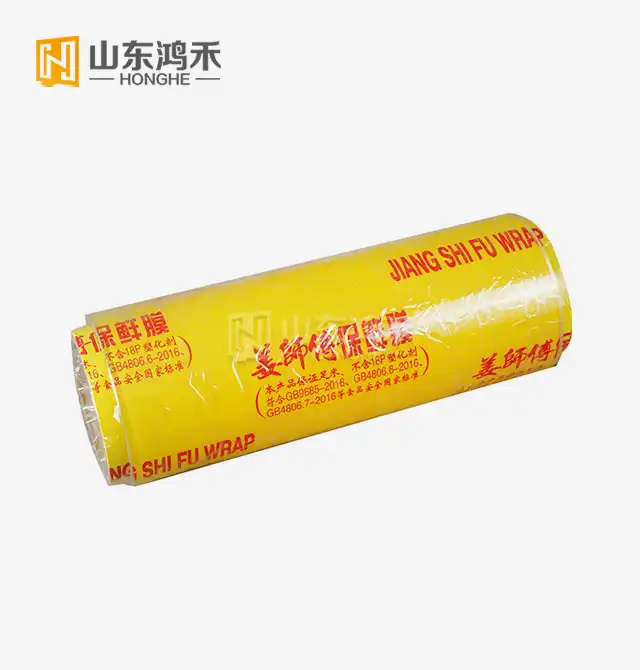
Best Practices for Using PVC Food Wrapping Film in B2B Procurement
Successful PVC film purchasing requires a systematic approach to certified verification, provider eligibility, and application-specific requirements. These procedures provide constant quality while minimizing the risks associated with non-compliant items or inappropriate applications.
Certification and Quality Verification
Procurement techniques should need relevant certification documents, such as FDA, ISO 22000, and any relevant regional food contact certificates. Supplier audits must validate the quality control processes and trace the acquisition of materials back to approved resin suppliers. Regular batch testing techniques provide consistent performance and security compliance throughout the supply chain.
Application Guidelines and Storage Requirements
Proper storage conditions maintain film performance characteristics and prevent degradation that could compromise safety or functionality. Recommended storage temperatures range from 15-25°C with relative humidity below 70% to prevent moisture absorption. UV protection prevents plasticizer migration and maintains optical properties during extended storage periods.
Supplier Partnership Development
Long-term supplier relationships enable customization opportunities, including for specialized materials such as PVC Food Wrapping Film, and ensure priority allocation during market disruptions. Qualified suppliers provide technical support for application optimization and regulatory updates. Collaborative relationships facilitate development of specialized formulations tailored to specific product requirements or emerging regulatory standards.
Shandong Honghe Plastics: Your Trusted Manufacturing Partner
Shandong China Honghe Composites Corp., Ltd. has established itself as a leading manufacturer of high-quality polyvinyl chloride (PVC) films since its foundation in 2017. Our facility, situated in the autonomous region of Shandong near Qingdao Port, offers easy transportation access for global distribution. Our advanced production equipment and disciplined workshop provide consistent quality output that fulfills international food safety standards.
Quality Certifications and Standards
Our vast certification portfolio includes ISO, CE, and FDA approvals, which prove our commitment to global quality standards. Additional Bachelor of Science in Communications and W CA certifications reflect our dedication to social responsibility and workplace standards. Third-party audits are carried out on a regular basis to ensure continuous compliance with shifting regulatory requirements in global markets.
Product Customization and Service Excellence
Our production skills enable significant customisation to suit individual client requirements. Customization options include thickness modifications, breadth combinations, and specialty additive packages for improved performance. We provide free sample services, allowing consumers to assess the quality of goods before committing to bigger purchases.
Applications and Market Versatility
Our Pva Food Wrapping Film is useful for a variety of purposes, including food packing, refrigerator storage, restaurant operations, and residential use. Our product line's adaptability allows us to meet diverse performance needs across market sectors while keeping constant quality standards. Bulk ordering capabilities meet large-scale buying demands at low prices.
Conclusion
The safety profile of PVC Food Wrapping Film stands on solid scientific foundation, supported by decades of research and regulatory oversight. Modern formulations eliminate historical concerns while delivering superior performance characteristics compared to many alternatives. Procurement success depends on working with certified suppliers who maintain current compliance standards and provide consistent quality assurance. The technical advantages of PVC films, including enhanced barrier properties and mechanical performance, often justify their selection despite higher material costs. Understanding these facts enables informed purchasing decisions that balance safety, performance, and economic considerations effectively.
FAQ
Q1: Is PVC Food Wrapping Film safe for direct contact with all food types?
A: PVC films certified by the FDA are safe to use in direct contact with the majority of food categories, including fresh produce, animal products, such as and prepared meals. Specific migration testing demonstrates safety across many food simulants with varying pH levels and fat content. However, very high-fat diets or prolonged high-temperature exposure may need specialist formulations.
Q2: What storage conditions preserve PVC film quality and safety?
A: In regions sheltered from direct sunshine, optimal storage temperatures range from 15 to 25 degrees Celsius and humidity levels are less than 70%. These settings prevent chemical migration and keep mechanical characteristics consistent during the shelf life. When films are stored properly in their original packaging, they may be used for up to 24 months after they were manufactured.
Q3: How can procurement teams verify supplier compliance with food safety standards?
A: Verification involves up-to-date certification paperwork, independent audit reports, and individual batch migration testing data. Suppliers should produce certificates regarding analysis per each shipment and provide traceability back to their initial source. Regular supplier reviews and inbound inspection processes maintain ongoing compliance across the supply chain.
Partner with Shandong Honghe Plastics for Your PVC Film Needs
Are you ready to get dependable, approved PVC Food Packing Film for your company's operations? Shandong Hong He Plastics combines production quality and quick customer service to satisfy your individual packaging needs. To meet the different procurement demands of our customers, we provide complete technical assistance, affordable bulk pricing, and variable order amounts. Write to us at tony@sdhhsl.com for more information about your needs and obtain free samples. Visit sdhhsl.com to see our whole product portfolio and learn why major organizations chose us as their PVC Food Wrapped Film supplier.
References
1. European Food Safety Authority. "Scientific Opinion on the Safety Assessment of the Substances Used in Food Contact Materials." EFSA Journal, 2018.
2. U.S. Food and Drug Administration. "Guidance for Industry: Preparation of Food Contact Notifications for Food Contact Substances." FDA Center for Food Safety and Applied Nutrition, 2020.
3. Plastic Industry Association. "PVC Food Packaging: Safety and Performance Characteristics." Technical Report Series, 2019.
4. International Journal of Food Science. "Migration Studies of Plasticizers from PVC Food Contact Materials." Research Article, 2021.
5. Society of Plastics Engineers. "Advances in Food-Grade PVC Formulations and Safety Assessment." Annual Technical Conference Proceedings, 2020.
6. Packaging Technology and Science. "Comparative Life Cycle Assessment of Food Wrapping Films." Environmental Impact Study, 2019.