



What Thickness of Machine Grade Cling Film Is Best for Your Line?
The ideal thickness of machine grade cling filmhttps://www.sdhhsl.com/pvc-cling-film/machine-grade-cling-film will vary depending on the wrapper, the product, and the storage environment. Most of the time, I see PVC film between 10 and 14 microns, which is about 39 to 55 gage, on automatic food film lines. Pallet stretch film is a different kind of film that is usually between 12 and 35 microns thick. Start with the thinnest film that can seal well, not tear, and run at the speed of your line without snapping. Then test the choice to make sure it's the right one, since a micron number on a spec sheet can't tell you how well it will work in real life.
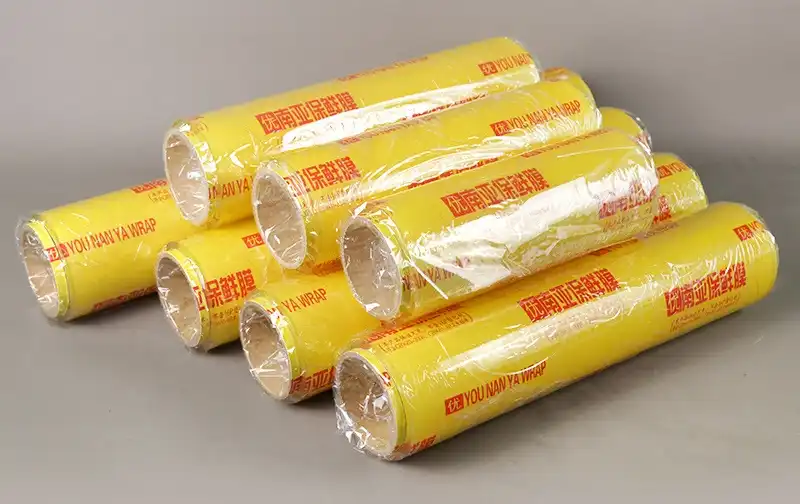
Machine Grade Cling Film Thickness Guide: Common Micron Ranges
People first ask about thickness, so that's where I'll start.
Why the Micron Number Alone Is Not Enough?
One thousandth of a millimeter is one micron, and it only tells you how thick the film is. It doesn't say how the film stretches, seals, or stands up to a sharp tray corner. Because of the quality of the resin, the additives, and the tension of the winding, two rolls of the same thickness can act in very different ways on the same wrapper. How the load is transported, the type of machine, the risk of punctures, and the weight of the load all affect the right choice. If the film is too thin, it could break or let the pack come loose. Too thick of a film costs more and can take longer to seal. That's why I think of thickness as a part of a full specification.
Typical Ranges for Food Lines and Pallet Lines
A lot of machine grade cling film used to automatically wrap food is between 10 and 14 microns thick. Most of the time, light, regular trays do well at the bottom. The top end may be needed for meat trays with edges made of bone or fruit and vegetables with firm stems. Stretch film for pallets is cut on a different scale. More often than not, it is made from LLDPE, and the thickness is usually between 12 and 35 microns. A 17-micron film works well for standard pallets, a 20- to 23-micron film works well for heavier or uneven loads, and a 25- to 35-micron film works well for industrial goods with sharp edges. Don't take these ranges as gospel; they're just starting points. Each one must be confirmed by production testing.
Converting Microns to Gauge
Lots of people in the US still ask for film in gages or mils instead of microns. Twenty-four microns are equal to one mil, and one mil is equal to 100 gage. Ten microns are equal to 39 gage, twelve microns are equal to 47 gage, and fourteen microns are equal to 55 gage. To give you an idea, pallet films are about 67 gage at 17 microns and 91 gage at 23 microns. I think that every purchase order should have both units written on it. This easy habit keeps quotes from different suppliers from being mixed up. It also helps your warehouse staff make sure that new rolls are in line with the approved specifications.
How to Choose the Best Thickness for Your Packaging Line?
Getting a good look at your product and equipment is the first step to making a good choice.
Match the Wrapper and Its Stretch System
The rules are set by your wrapper. Check the model, width of the film, size of the roll core, speed of the line, and range of tensions. Automatic wrappers from Ishida, Digi, Ulma, and Omori stretch the film mechanically, then use a hot plate to cut and seal it. If the machine's stretch setting goes past the film's maximum length, the film breaks. An elongation at break test to ASTM D882 often shows that this kind of film can stretch between 200% and 400%. Before you order, compare that number to the way your stretch is set now. Make sure that the temperature of the heat plate is in the same range as the film's sealing range.
Consider Product Shape and Puncture Risk
Check out the film's touch. Smooth boxes and rigid trays don't put much stress on the film. Foods with bones, crusty bread, and fresh fruits and vegetables that still have stems make puncture points. It's also harder for the film to stretch when the trays are heavier. If you wrap a bunch of different things on one line, test the hardest one first. You can move up one step in thickness or make the contact points softer with a better tray design if a thin film tears on that item. Change only one thing at a time and move slowly so you can figure out what went wrong.
Standard Machine Film vs Pre-Stretch Film
There is a second choice for pallet lines. The person who wraps the standard machine film stretches it as it goes on the load. Before it hits the load, pre-stretch film is stretched, so a 17-micron pre-stretch film doesn't act like a regular 17-micron film. Pre-stretch systems can cut down on film use, but they need equipment that works with them and the right carriage settings. Compare how much film is used per pallet, how often it breaks, how many wraps it has, and the amount of downtime before switching from a thicker standard film to a thinner pre-stretch film. Since food tray lines don't work the same way, this comparison is mostly useful for warehouse and logistics teams.
Machine Grade Cling Film Material and Application Considerations
The material and how it will be used determine the final size just as much as the thickness itself.
PVC Material and Why It Suits Food Wrapping
The PVC we use to make our machine grade cling film is very good. PVC is clear, sticks to itself naturally, and is easy to stretch, so it works well for automatic cutting and wrapping on trays. Cutter-box film is not the same as machine grade film, which is also called auto-grade. It has extra slip and a higher winding tension, which help it go through machine rollers. Cutter-box film is stickier and softer, and it can get stuck in machines that do automatic work. As you shop, keep PVC food film and LLDPE pallet film separate. When you mix them, you get the wrong orders because the materials, thickness ranges, compliance rules, and uses are all different.
Selecting Thickness for Different Applications
Our PVC film is often used to package food, keep it cool, in food service, and in homes. When it comes to food packaging and central kitchens, the right thickness depends on the wrapper and the food. For refrigeration, test the film at the actual storage temperature. This is because clarity, cling, and fogging are all affected by cold. A film that sticks well to bowls and trays is often what food service kitchens need. Users in homes like things that are easy to handle. Warehouse and pallet teams should keep stretch film on hand to wrap loads on the outside. I think you should pick a different thickness for each use because the thickness you choose for one setting doesn't always work for all four.
Compliance and Food Contact
Any film that comes in contact with food needs to follow certain rules. Title 21 of the Code of Federal Regulations, Parts 177 and 178, tells the FDA how to regulate polymers and additives that come into contact with food in the United States. Buyers in the EU must follow Regulation (EU) No 10/2011. The main problem with PVC is that plasticizers can move around, which can happen when foods are fattened. Most of the time, polyolefin machine film is better for pure oils and fats. Shandong Honghe Plastics Co.,Ltd. is certified by BSCI, WCA, CE, and FDA, among others. Before you sign off on a specification, ask any supplier for documents that match the type of product you're selling and the market where it will be sold.
How to Test and Buy Machine Grade Cling Film?
Time and money are saved by having a good trial and a clear brief.
Run a Controlled Line Trial
The best way to get an answer is to do a line trial. Use the real wrapper, the real goods, and the normal conditions for your shift. Keep track of how much film is used per pack, how many snaps are made, broken seals, jams, and roll changes. After the packs have been stored in the fridge, check the clarity and fog. Make sure that the bottom seal stays closed on food trays. Most heat plates are 110°C to 140°C, so make sure the sealing range of the film fits your setting. For pallet lines, make sure to check the film relaxation after transport and load shifting. Don't look at the cost per roll, but at the cost per good pack or pallet.
Prepare a Specification Brief
Write down what you need before you ask for quotes. Include the use, type of product, desired thickness, width, roll length, core size, wrapper model, stretch setting, and yearly volume. Add the market you want to reach, the level of cling, and whether you need packaging or labels. Then make a list of the papers you need, like certificates and food-contact statements. With a clear brief, all suppliers can quote on the same item, so it's fair to compare prices. It cuts down on sample time too. You can send us this brief, and we will go over it with you because our film can be changed to fit the needs of each client.
Common Mistakes to Avoid
Most people make the mistake of not adding up the total cost before buying the cheapest or thinnest roll. A small price gain can be lost in snaps, rework, downtime, and wasted goods. It's also a mistake to think that thicker means stronger. Just as important are the quality of the resin, how well it stretches, and how well it rolls up. Using the same thickness for all of your products also leads to waste or failure. Bad storage also leads to problems. When the temperature goes above 30°C, the plasticizer can move to the surface, the roll can stick together, and the film can break while being unrolled. Keep rolls in a cool, dry place. Before each order, check the core size and roll width.
Recommended Thickness by Use Case and Supplier Choice
With these things in mind, this is where I would start.
Recommended Starting Points
I would start with a machine grade cling film in the 10 to 14 micron range for regular trays when used for automatic food wrapping. For sharp or heavy items, I would move up. For wrapping pallets, 17 microns is best for stable cartons, 20 to 23 microns is best for heavier or mixed loads, and 25 to 35 microns is best for tough industrial goods. For cold storage and high-speed lines, an automatic choice is not enough. Machine and temperature tests are needed. Every number here is just a guess. Final approval should depend on how much film was used, how often it broke, how well it sealed, and how much it cost per wrapped load.
Why Work with a Specialized Supplier
The film specs are linked to the real machine and load needs by a specialized supplier. If you have good technical support, they will look at your wrapper model, film width, roll format, and operating temperature. When it comes to automated lines and repeat distributor programs, it's most important to have consistent raw materials, thickness control, and batch records. A supplier who has control over the whole factory can also help with samples, line trials, and planned large-scale production. In this case, the supplier is more than just a film vendor; they are also a procurement partner. Problems are fixed at the source, so buyers don't have to waste film or make stops that weren't planned.
What Shandong Honghe Plastics Co.,Ltd. Offers
Since its start in 2017, Shandong Honghe Plastics Co.,Ltd. has been making PE and PVC cling film, disposable TPE, CPE, and PE gloves, and stretch film. In Liu Guanzhuang Town, Shandong Province, our factory is close to Qingdao Port, which makes shipping easy. Our PVC machine grade cling film can be changed to fit the needs of our customers, and we offer free samples for testing. We are certified by ISO, CE, FDA, BSCI, and WCA. We have a lot of stock, offer OEM and ODM services, offer competitive prices, and offer after-sales support 24 hours a day, 7 days a week. You can try out our film on your own wrapper before you buy a lot of it.
Conclusion
There is no one micron number that tells you the best thickness for machine grade cling film. It depends on the whole packaging system. PVC film for food wrapping lines is usually between 10 and 14 microns thick, while LLDPE pallet film is between 12 and 35 microns thick. Because of this, the two types of film need different specifications. The choice is based on the type of wrapper, the stretch setting, the shape of the product, the risk of puncture, and the storage temperature. Compliance and the material used are also important, especially when it comes to plasticizer migration and food-contact rules for PVC. An answer that is more useful than price per roll is one that keeps track of snaps, seal quality, film use, and cost per good pack. A buyer can find a stable, cost-effective setting by starting with a thickness in the middle of the range, making small changes, and measuring the results of each change.
FAQ
What thickness works best for automatic tray wrapping?
Most machines that wrap food automatically use PVC film that is 10 to 14 microns thick. If you start in the middle of that range, you can make changes after a line trial based on how the snaps, seals, and edges of the product look.
Can PVC machine film touch fatty foods?
Plasticizers are in standard PVC machine film. Most of the time, polyolefin machine film or PVC certified for fatty contact is best for pure fats and oils. Before you give the go-ahead for a movie, look over the migration papers.
Why does my film snap on the wrapper?
Most of the time, snaps happen when the tension settings don't match up with the film's elongation limit. Tears can also start from roll edges that are nicked. Keep rolls cool and dry. If you store them above 30°C, they may stick together and break when you try to unwind them.
How do I request samples?
Tony@sdhhsl.com with your wrapper model, thickness goal, width, and volume. We offer free samples for you to test on your line.
Request the Right Machine Grade Cling Film Specification from Shandong Honghe Plastics Co.,Ltd.
Looking for a supplier of machine grade cling film who provides free samples and custom orders? Shandong Honghe Plastics Co.,Ltd. makes PVC film and is certified by ISO, CE, and FDA. They have a large inventory and offer 24-hour customer service after the sale. To get a sample and price quote today, email tony@sdhhsl.com with your wrapper model, thickness goal, width, and annual volume.
References
1. ASTM International, Standard Test Method for Tensile Properties of Thin Plastic Sheeting (ASTM D882), 2018
2. ASTM International, Standard Test Method for Haze and Luminous Transmittance of Transparent Plastics (ASTM D1003), 2021
3. U.S. Food and Drug Administration, Code of Federal Regulations Title 21, Part 177: Indirect Food Additives: Polymers, 2023
4. European Commission, Regulation (EU) No 10/2011 on Plastic Materials and Articles Intended to Come into Contact with Food, 2011
5. Sina Ebnesajjad, Plastic Films in Food Packaging: Materials, Technology and Applications, William Andrew, 2013
6. Gordon L. Robertson, Food Packaging: Principles and Practice, CRC Press, 2012