



PE Food Cling Film vs PVC: Which Material Fits Your Market Best?
Most U.S. commercial purchasers choose PE food cling filmhttps://www.sdhhsl.com/pe-cling-film/pe-food-cling-film for plasticizer-free food contact, moisture management, and recycling-minded sourcing. PVC cling film is still suitable for strong cling and long-lasting machine settings. Food kind, wrapping equipment, storage temperature, and compliance documentation determine the response. I prepared this guide for buying managers, food processors, and retail supply teams that require precise comparisons before ordering. Below, I compare both materials, discuss important parameters, and explain how Shandong Honghe Plastics Co.,Ltd. supports sample testing and bulk delivery.
PE Food Cling Film vs PVC Cling Film: Material and Performance Fundamentals
What Each Material Is Made Of
Polyethylene (LDPE or LLDPE) is cast or blown into PE cling film. Polyvinyl chloride resin is hard and requires plasticisers to become sticky. The difference influences everything thereafter. PE film is flexible without plasticisers, so purchasers have less migration concerns with fatty goods like cheese and cooked meat. DEHA, a plasticiser associated with PVC wrap, has an EU migration limit of 18 mg per kilogram of food. No polymer name may substitute a formulation-specific compliance assessment.
Cling, Clarity, and Strength
PVC film has good cling, clarity, and conformability to irregular shapes. PE film stretches and punctures well for tray, bowl, and bulk-wrapping. Our PE film has excellent cling for a tight seal, good sight, and puncture resistance against rips and leaks. Since glass, ceramic, stainless steel, and foam trays respond differently, measure cling on your container material. Thickness, resin quality, and winding stress affect outcomes, therefore data sheets seldom answer questions. A brief experiment using actual parcels is more accurate.
Barrier and Temperature Behavior
Strong moisture and mild oxygen barriers characterise our PE film. This balance reduces produce, meat, and prepared meal moisture loss during short-term fresh storage. Because of its oxygen permeability, PVC has long been utilised for fresh meat trays. Individual temperature testing is needed. Cold storage, refrigerated exhibition, and reheating stress films differently, therefore I wouldn't use a general temperature claim. Request temperature restrictions and test results from any provider that fit your purpose.
PE Cling Film vs PVC: Key Decision Criteria and Application Fit
Compliance and Documentation Buyers Should Request
The FDA regulates food-contact polyethylene under 21 CFR 177.1520 for olefin polymers. Regulation (EC) No 1935/2004 governs food contact materials in the EU, while Regulation (EU) No 10/2011 governs plastics. Our facility is ISO, CE, FDA, BSCI, and WCA-certified, and our PE film fulfils FDA and EU food contact regulations. Words like "food grade" mean nothing without documentation. Request a food-contact declaration, migration test results, and restricted-substance statement from any source before authorising any film.
Meat, Seafood, and Cold Storage Applications
Meat and shellfish require a reliable seal under cold circumstances and puncture resistance around bones and edges. Water loss causes surface drying and freezer burn, hence a moisture barrier is important. PE food cling film protects wrapped portions and trays against contamination during cold storage. Retail meat trays made of PVC are popular for their cling and clarity. I recommend testing at your storage temperature and on wet, fatty surfaces since adhesion in a cold environment might vary from a dry lab bench.
Produce, Catering, and Household Use
Shoppers require visibility and a drying barrier for fresh food. Restaurants and caterers like dispenser fit, quick unwinding, and rapid hand wrapping for leftovers, dough, and ready supplies. Film that sticks to bowls and dishes without tangling is preferred by homeowners. To fit these conditions, our PE film comes in 300 to 1,500 meters per roll and unrolls smoothly without tangles. Oil resistance and package appearance should be tested on bakery and prepared food containers. Choose the right material, not because it's popular.
PE Film Specifications: How to Select the Right Product
Thickness, Width, Length, and Core Size
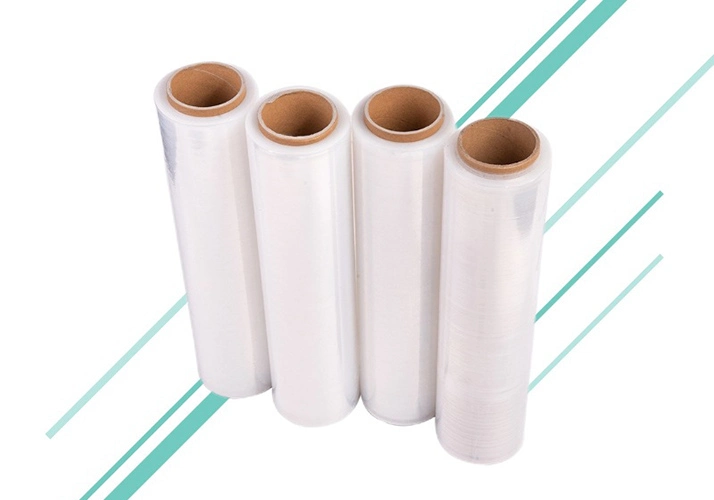
We sell transparent PE food cling film in 8–12 micron thickness, 300–500 mm width, and 300–1,500 meters per roll. Core diameters are 38 or 76 mm, and thickness and breadth are adjustable. Strength, stretch, puncture resistance, and wrapped unit cost depend on thickness. The thinnest film may not be the cheapest after breaking and rewrapping. Rolls for tray lines and bulk wrapping are wider than those for kitchen dispensers. Make sure your dispenser or machine shaft core size matches before ordering.
Performance Features That Affect Daily Operation
Four characteristics generally determine a film's line performance. High-cling seals keep food fresh. Shoppers and kitchen workers can view items well. Strong puncture resistance prevents rips and leaks. Simple unrolling without knots saves time and film. The film fulfils FDA and EU food contact regulations and is manufactured of non-toxic food-grade PE. These qualities matter most in supermarket packaging, central kitchens, and cold storage.
Customization and Free Samples
For private-label projects, we provide ODM and OEM customisation of PE food cling film for width, thickness, length, and core diameter. The availability of free samples matches how most procurement teams work: test, then approve. Request samples alongside your present PVC or PE film and compare wrapping speed, breakage, cling and package look on your line. Send us your food kind, container, size, and yearly volume for a suitable film construction. Proof of trial findings speeds internal approvals.
PE vs PVC Sustainability, Recycling, and Total Cost
Recycling and Sustainability Considerations
LLDPE and LDPE have resin code 4, whereas PVC has code 3. PVC is a pollutant in most plastic recycling streams, thus some purchasers avoid it. Food contamination, labelling, local collection programs, and processing capacity determine food wrap recyclability. Thin films are collected at shop drop-offs in the US, and food-soiled wrap is not accepted. Buyers should seek suppliers about material structure and verify local guidelines before accepting a recycling claim.
Total Cost per Wrapped Package
Roll price only partially explains. Fair comparisons include film yield per roll, breakage, rewrapping, wrapping speed, labour, storage space, freight, and import prices. Only if it retains your line does a thinner film consume less material. Cost per wrapped package = roll cost / number of packages per roll in a trial. High-volume lines with 1,500-meter rolls have fewer changeovers, saving labour time. Buying in bulk from a manufacturing allows volume pricing.
Stable Supply and Logistics
An unreliable supply of PE food cling film costs more than a tiny price differential. Repeatable thickness, cling, and packing keep machines going. Export transit is easy from our facility in Liu Guanzhuang Town, Shandong Province, near Qingdao Port. We use innovative manufacturing technology in a standard workplace, stock enough, and deliver quickly with logistical help. Before making a big purchase, ask about lead time, minimum order size, inventory levels, and claims. Services include 24-hour after-sales.
How to Choose Between PE and PVC Cling Film and Work with a Supplier
A Four-Step Selection Process
Define the food category, package form, storage temperature, shelf-life objective, and wrapping technique. Next, list compliance, thickness, breadth, length, cling, stretch, clarity, puncture resistance, and packaging specifications. Required safety and equipment should weigh more than optional. Use actual food, containers, dispensers, and equipment to test samples. Finally, match your volume and forecast to a supply model like standard rolls, special formats, OEM, or private-label manufacture. The usual error of picking by price or look is avoided by this arrangement.
What to Ask a PE Food Cling Film Manufacturer
Good suppliers provide more than quotes. Request technical data sheets, tolerances, food-contact notices, migration reports, sample rolls, timing, minimum order amounts, and quality-control methods. Determine resin type, target-market conformity, batch traceability, manufacturing capacity, and export experience. Shandong Honghe Plastics Co.,Ltd. was created in 2017 and makes PE and PVC cling, disposable TPE, CPE, or PE gloves, and stretch film. Our strict quality control and certifications aid supplier audits. Technical assistance and after-sales service are best assessed with a short trial purchase.
When PE or PVC Is the Better Fit
PE is ideal for purchasers that require flexible polyethylene-based film, a robust moisture barrier, unique formats, private-label choices, or recycling aims. When strong cling, high clarity, and machine settings are confirmed, PVC may fit. Neither material fits all markets. Choose from compliance, performance, equipment compatibility, heat exposure, and distribution demands. I can propose either PE or PVC cling film based on your test findings since we produce both.
Conclusion
Testing rather than assumptions determines the optimal PE food cling film or PVC food cling film for each market. PE has plasticizer-free construction, a robust moisture barrier, and resin code 4 labelling, whereas verified PVC has strong cling and clarity. FDA and EU compliance paperwork, application appropriateness for meat, produce, catering, and cold storage, right thickness, width, and core size, and overall cost per wrapped package influence the choice. Samples on genuine equipment and stable supply decrease risk before large purchases. Buyers who record these criteria may choose a film that preserves food, reduces waste, and fulfils destination-market standards.
FAQ
Is PE food cling film safe for direct food contact?
Yes, when the formulation meets destination-market rules. Our PE film is made from safe, non-toxic food-grade PE material and meets FDA and EU food contact standards. Request a declaration for your specific order.
Can I use it in a microwave?
Microwave suitability depends on the specific product, so I recommend testing and checking the labeling. Our product details do not list microwave use, so please confirm with us first.
What thickness should I choose?
Our film ranges from 8 to 12 microns. Choose based on food shape, puncture risk, wrapping method, and shelf-life goals, and test samples first.
Can you customize the film and provide samples?
Yes. We customize width, thickness, length, and core diameter, offer ODM and OEM services, and provide free samples.
Request a PE Food Cling Film Quote from Shandong Honghe Plastics Co.,Ltd.
Shandong Honghe Plastics Co.,Ltd. is ready to support your search for a PE food cling film manufacturer with free samples, customization, and fast delivery from our facility near Qingdao Port. Send your food type, dimensions, and volume to tony@sdhhsl.com, and our team will reply with specifications and a quotation. You can also review our full product range at sdhhsl.com.
References
1. Code of Federal Regulations, Title 21, Section 177.1520 (Olefin Polymers), U.S. Food and Drug Administration, 2024.
2. Commission Regulation (EU) No 10/2011 on Plastic Materials and Articles Intended to Come into Contact with Food, Official Journal of the European Union, 2011.
3. Regulation (EC) No 1935/2004 on Materials and Articles Intended to Come into Contact with Food, Official Journal of the European Union, 2004.
4. Food Packaging: Principles and Practice, 3rd Edition, CRC Press, 2012.
5. Food Packaging Technology, Blackwell Publishing, 2003.
6. Contamination in Food from Packaging Material, Journal of Chromatography A, 2000.